


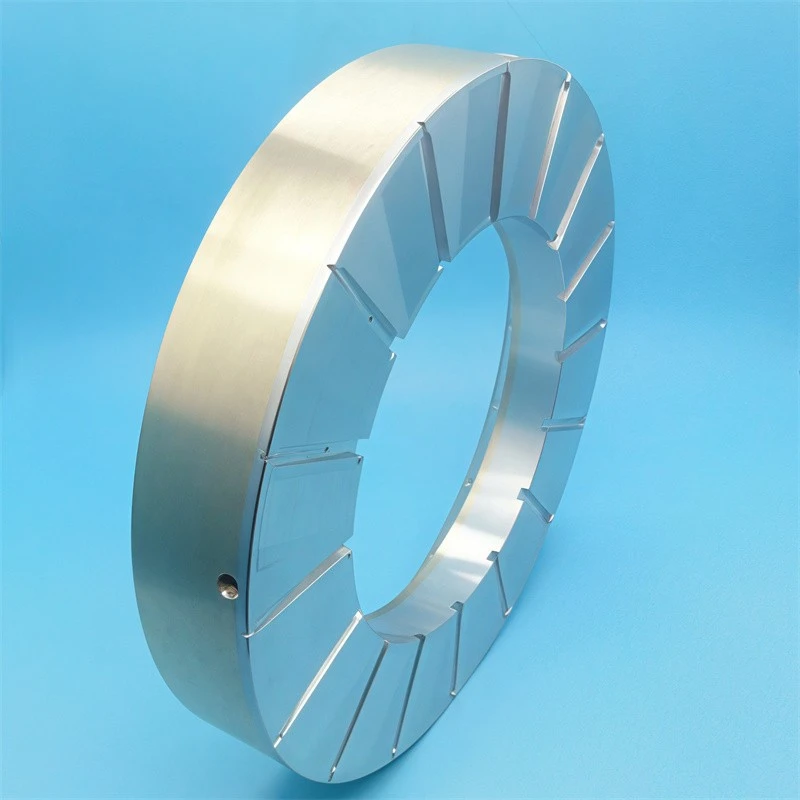
Material selection of thrust bearing is never random. The alloy determines the load the surface can withstand before bending. It also determines the speed at which the oil film remains at an appropriate thickness. It determines how hard dirt particles can push the surface rather than scratch the shaft. A Tin Bronze Thrust Bearing are made from copper-tin system. It has been used in factories since the 19th century. But the specific mix choices inside the system-how much tin, how much lead, how much phosphorus, if zinc is added-can give your face have very different intensity and rubbing behaviors. This paper will describe what the mixture is made of, why each metal exists, and how changes in the mixture change the way bearings work.
The Copper–Tin Binary System: Foundation of the Alloy
Tin bronze is basically a solid mixture of tin dissolved in a copper base. copper base was shaped like a cube with a face core. In a stable state, tin can only dissolve in copper at room temperature with a solubility of about 1 wt.%. But bearing alloys typically contain 8–12 wt.% tin. This extra tin stays in the mix as the casting and cooling rates are used in production, preventing the metal from returning to its stable state. So the tin stays in the form of an alphaphase solid solution throughout the mixture.
Massalski (1990) made a better job of mapping the copper-tin phase in later CALPHAD studies, showing three important phases of the cast alloy:
α-phase: This is the copper-rich solid mixture that forms up the main body. Soft and bendable. It also gives bearings the ability to change shape and allow dirt to enter. This is why bearing alloys can handle shaft surface collisions.
δ-phase (Cu31Sn8): is a tin-rich intermetallic that forms at the edge of the grain as the metal slowly cools. At 8–12% tin, a deltaphase is bound to form. This stage is hard and brittle. Its position inside the alphaphase controls the alloy's ability to withstand repeated stresses.
ε-phase (Cu3Sn) and η-phase (Cu6Sn5): These are other intermetallics that occur at contact points and at the edge of particles under certain cooling conditions. When they have only a small fraction, they increase surface hardness without reducing too much flexibility.
The mechanical result of adding more tin is an almost linear rise in tension and stiffness. This is achieved by solid-solute enhancement. But at the same time, the more δ-phase there are, the less bendable they are. The yield strength of sand-cast tin bronze is usually 120–145 MPa and 60 – 80 HB at 10% wt tin (ASM International, 1990).
Standard Alloy Grades Used in Thrust Bearing Applications
The Copper Development Association and ASTM name several tin bronze mixtures used in bearings. The most common grades of thrust job are:
C90300 (88-0-4): 88% Cu, 8% Sn, 0% Pb, 4% Zn. Zinc is added mainly to remove oxygen and reduce sand castings holes. Brinell hardness is 65–75 HB and tensile strength 275 – 310 MPa. This is a basic combination of conventional thrust job without the need for lead (ASTM B505).
C90500 (88-10-0-2): 88% Cu, 10% Sn, 0% Pb and 2% Zn. Higher tin amount increases stiffness to 75-85HB and allows bearings to last longer under frontand back contact. It is slightly less integrated than the C90300.
C90700 (89-11-0-0): Contains 89% Cu, 11% Sn, lead and zinc. This high tin, unleaded blend gives you the toughest standard tin bronze, weighing 80–90 HB. It is used in thrust job, where dirt entry is less important than abrasion resistance under high contact pressures.
C93200 (83-7-7-3): 83% Cu, 7% Sn, 7% Pb, 3% Zn. This is lead tin bronze. Technically, it's a different family of alloys, but bearing catalogues pairs it with tin bronzes. The lead part (discussed in the next section) changes a lot of the rubbing behavior.
The Role of Lead: Lubricant Reservoir in the Matrix
Lead cannot be mixed with copper. As the metal hardens, it turns into tiny droplets. These droplets spread through alphaphase objects. The lead pendants do two trash-related jobs. First, on first contact, they are smeared on the bearing face. This allows the thin, smooth layer to start and under low fuel consumption conditions. Next, they form small holes in the surface. Between normal oil lubrication cycles, these holes can store oil for later.
In C93200, drops of Pb is sufficient to reduce dry friction by about 20-30% at 7 wt percentagelead, while unleaded mixtures decreased by about 20-30% at the same load and speed (Stachowiak & Batchelor, 2014). The drawbacks are lower pull (C93200 is usually C93200 220 – 240 MPa, C90300 is usually 275–310 MPa) and shorter front and back bending life.
Lead has little additional friction benefit for tin-bronze thrust bearings that always operate above the film speed in an oil lubrication system. The oil film acts to separate the surfaces. Lead is important when switching on, off or on, or when fuel consumption is low. These include low-speed pivots, crane hooks, and hydraulic cylinder pins. For fast, uninterrupted thrust job, lead-free mixtures with phosphor-bronze traits are usually a better option.
Phosphorus: Deoxidation and Strengthening
Phosphorus is added to molten tin bronze, mainly to expel oxygen. It is added as a copper phosphorus master alloy (usually 8–15% P). When the metal melts, phosphorus first binds to dissolved oxygen to form diphosphate pentaoxide. It floats on slag and is carried away. This removes the oxide bits from the casting. This makes the bearing stronger under repeated stress because it eliminates possible cracks.
When phosphorus remains dissolved after oxygen removal --usually at 0.10 --0.35 Weight Percentages --it scatters small Cu3P particles around the edge of the grain. This hardening effect increases hardness by 5–15 HB, making the elastic modulus slightly higher than the phosphorus-free mixture. Alloys that intentionally contain more than the amount of additional phosphorus required for deoxygenation are called phosphor bronzes ( (C51000–C52400 series under ASTM B103). They are not called tin bronzes. But in practical engineering, the difference is quantity, not type. Both use the Cu. Many bearing specifications accept both names, depending on the tin and phosphorus balance (ASTM B103).
Zinc: Porosity Reduction and Cost Efficiency
Adding zinc at a 2 – 4 wt.% reduces the melting temperature of tin bronze, allowing the liquid metal to flow better when poured. This reduces shrinkage holes in sand and spin castings. This is the main job of zinc in bearing alloys. At this low level, it does not increase the strength of the metal.
When zinc levels exceed 4 wt.%, the risk of washing it away in water or acidic environments is higher. Therefore, bearing job exposed to water-based cutting fluid or acidic mineral water tends to choosezinc free or low zinc mixtures. They accept a slightly higher drilling risk, or compensated for it by spin casting rather than static sand casting (Taillard et al.., 2007, cited in Copper Development Association, CDA Publication 144).
Casting Process and Its Effect on Composition Homogeneity
The distribution of tin on the casting is different unless you can control the casting process. The main tin structure problems of tin bronze castings are that there is less tin in the central part and more tin in the edge of grain. The thicker the parts, the slower the cooling rate, and the higher the tin content, the worse the coloring effect.
Spin casting is the main method to manufacture circular bearing shells and thrust washer. The spin force during hardening pushes heavier phase outward. For tin bronze (density about 8.8 g/cm3), a small amount of tin accumulates on the outer edge. On thrust gaskets, this outer edge is the loading surface. ISO 1083 (spheroidal graphite iron) provides a basic method for measuring microstructures. For tin bronze specifically, ASTM B505 Standard Specification for Copper-Based Alloy Continuous Castings sets the mix and strength rules for cast bars and tubes. Thrust washers are usually cut from these materials.
Heating at temperatures of 400–450°C for 2-4 hours evens out the structure and reduces cores. This allows tin to spread throughout the alphaphase. This makes hardness of the whole part more uniform. This heat treatment is normal for worked phosphor bronze strip (C51000), but less common for casting bearing alloys. Unless the results of an intensity test force you to do it, the cost is hard to prove.
Mechanical and Tribological Properties: Numbers That Matter
Maximum allowable contact pressure (P): For C90300 lubricated with full-film oil, the static pressure limit is usually 48 – 55 MPa (7,000–8,000 psi) according to ASTM B505 data. The actual working pressure drops to 10 – 20 MPa with back-and-forth or low oil exposure.
Photovoltaic Limit: The product of bearing pressure P (MPa) and sliding velocity V (m/s) represents the total thermal and mechanical load on the bearing face. For unleaded tin bronze used in oil lubrication operations, PV limits of 2.0–3.5 MPa·m/s are normal. Leaded C93200 low yield strength of 1.5–2.5 MPa·m/s under the same conditions. This is true even though it has better low-oil rubbing (Khonsari & Booser, 2008).
Embedding: Soft alphaphase objects allow hard dirt particles to sink below the bearing surface. This prevents them from remaining on the shaft as a third-party agency. Ordinary tin bronze has a tin bronzes hardness of 65–85 HB, making it much softer than the hardened steel shafts they rub against (usually 55-65HRC = 595–832 HV). This softness is necessary for embedding work.
Fatigue strength: The fatigue limit of the 107-week C90500 is about 90–110 MPa under repeated bending (ASM Specialty Handbook, 1990). By comparison, lead C93200 has a temperature of 70–90 MPa. This is because lead droplets concentrate stress at one spot.

Comparison with Competing Bearing Alloys
Aluminium bronze (C95400: 85% Cu, 11% aluminum, 4% iron) has higher strength-tensile 550–620 MPa, hardness 160–180 HB-but you lose embedding and conformity. For thrust job with dirty oil or occasional dirt particle, the soft tin bronze body absorbs hard particles more safely than aluminium bronze. Aluminium bronze is prone to triple-body wear when particles settle on the rubbing surface (Stachowiak & Batchelor, 2014).
Bimetal bearings (steel-supported tin white metal or aluminium tin top layer) have a lower photovoltaic limit but are better conformability and embedded at very low speeds. Heavy thrust gaskets are made of all-tin bronze and work better when the load is mostly straight through. The running speed is non-stop and full oil film is maintained by a pressurized oil supply.
Summary
The combination of tin-bronze thrust bearings is not a fixed formula. It is a family of Cu-Sn alloys. The tin amount (8–11 wt.%) determines the balance between strength and flexibility. The amount of lead (0–7 wt.%) controls low-oil rubbing behavior. phosphorus amount (0–0.35 wt.%) removes oxide bits and hardens the particles to create additional stiffness. The zinc amount (0–4 wt.%) helps the liquid metal flow better during casting. Alpha The α-phase copper body has compatibility and dirt pushingin. The δ-phase and other grain edge particles increase hardness and abrasion resistance. Choosing the right mix means pushing the alloy's PV limit and dirt into line with actual oil conditions, dirt level and contact pressure. You shouldn't just choose to mix with the most tin.
References
- ASM International (1990). ASM Specialty Handbook: Copper and Copper Alloys. ASM International.
- Massalski, T.B. (ed.) (1990). Binary Alloy Phase Diagrams (2nd ed.). ASM International.
- ASTM B505/B505M-22. Standard Specification for Copper Alloy Continuous Castings. ASTM International.
- ASTM B103/B103M-22. Standard Specification for Phosphor Bronze Plate, Sheet, Strip, and Rolled Bar. ASTM International.
- ISO 1083:2018. Spheroidal graphite cast irons - Classification. International Organization for Standardization. (Referenced for microstructure quantification methodology.)
- Khonsari, M.M. & Booser, E.R. (2008). Applied Tribology: Bearing Design and Lubrication (2nd ed.). John Wiley & Sons.
- Stachowiak, G.W. & Batchelor, A.W. (2014). Engineering Tribology (4th ed.). Butterworth-Heinemann.
- Copper Development Association (2011). CDA Publication 144: Copper Alloys for Bearing Applications. Copper Development Association.
- Hamrock, B.J., Schmid, S.R. & Jacobson, B.O. (2004). Fundamentals of Fluid Film Lubrication (2nd ed.). Marcel Dekker.
- Szeri, A.Z. (2011). Fluid Film Lubrication (2nd ed.). Cambridge University Press.
- Wilcock, D.F. & Booser, E.R. (1957). Bearing Design and Application. McGraw-Hill.
- Brandes, E.A. & Brook, G.B. (eds) (1992). Smithells Metals Reference Book (7th ed.). Butterworth-Heinemann.